
By the start of 87, The Wild were also long gone from their Gardner Street studio. All the cool 24/7 parties moved to Orange Street, right around the corner from the iconic Chinese Theater. A recent building boom had produced several mostly-wheelchair-accessible, poorly built, half-occupied, future-overpriced-slum apartment complexes on the block. There they waited for rockers, strippers, and drug slingers to rent them. Ole and his generous girlfriend lived in a sparsely furnished place – futon, tables, record player, guitars, and bedroom set – serving as my rock ‘n’ roll home base and pre-buzz central.
There were scores of other neighbors from Hell on that block who took turns hosting parties for several night-day-nights. One night, I ran into Steven Adler at someone’s party and invited him over to Ole’s pad for a smoke-out. When I asked how his album was coming along, he left me with an impression he believed they might not ever get a record done. He told of his drum tracks long since completed, and with the advance money long gone, he was broke. Steven complained, “I should have bought a van with my advance money,” adding something or another about a place to sleep and the ability to haul his drums around.
None of that shit mattered to me, because I got slap-happy when The Cult put out their new, beyond-kick-ass record. Rick Rubin can do no wrong, and it seemed like honest-to-goodness heavy rock ‘n’ roll came a-rumbling back with Electric. Ole’s drummer, Mickey, and me saw The Cult open for Billy Idol at the Fabulous Forum. During the show, we became possessed, and then went on to speak in tongues for months – “Ya-yeah!”
As everyone bailed out, I yelled, “Get my chair from the trunk, fuckers.”
I went to lots of great concerts that summer. One of the more memorable gigs was Whitesnake and Deep Purple at Irvine Meadows. On our drive home from a spectacular show, we made a pit-stop at Jack in the Box. As we groggily grubbed, I heard alarmed shouts from the backseat. Looking back, I saw an almost-chest-high flame shoot up through my buddy’s crotch. As everyone bailed out, I yelled, “Get my chair from the trunk, fuckers.” Lesson: Don’t buy a car with the battery located under the back seat.
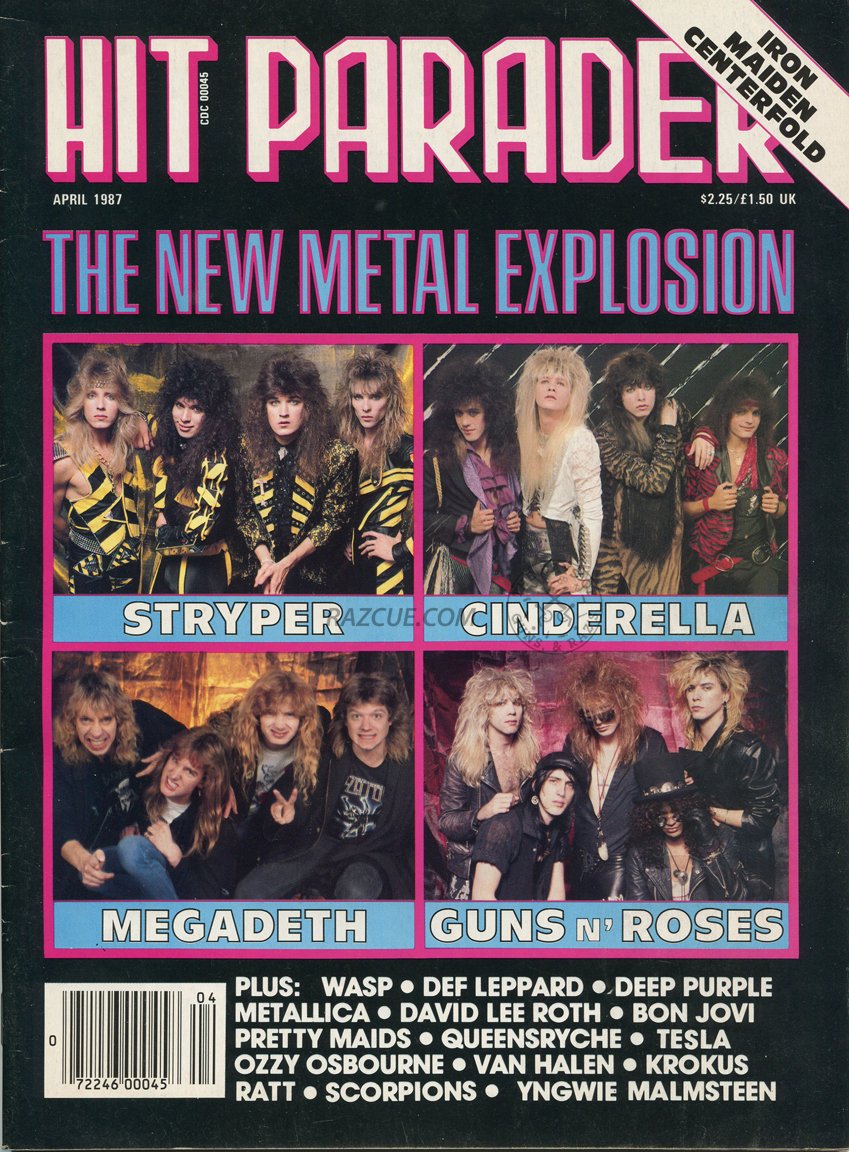
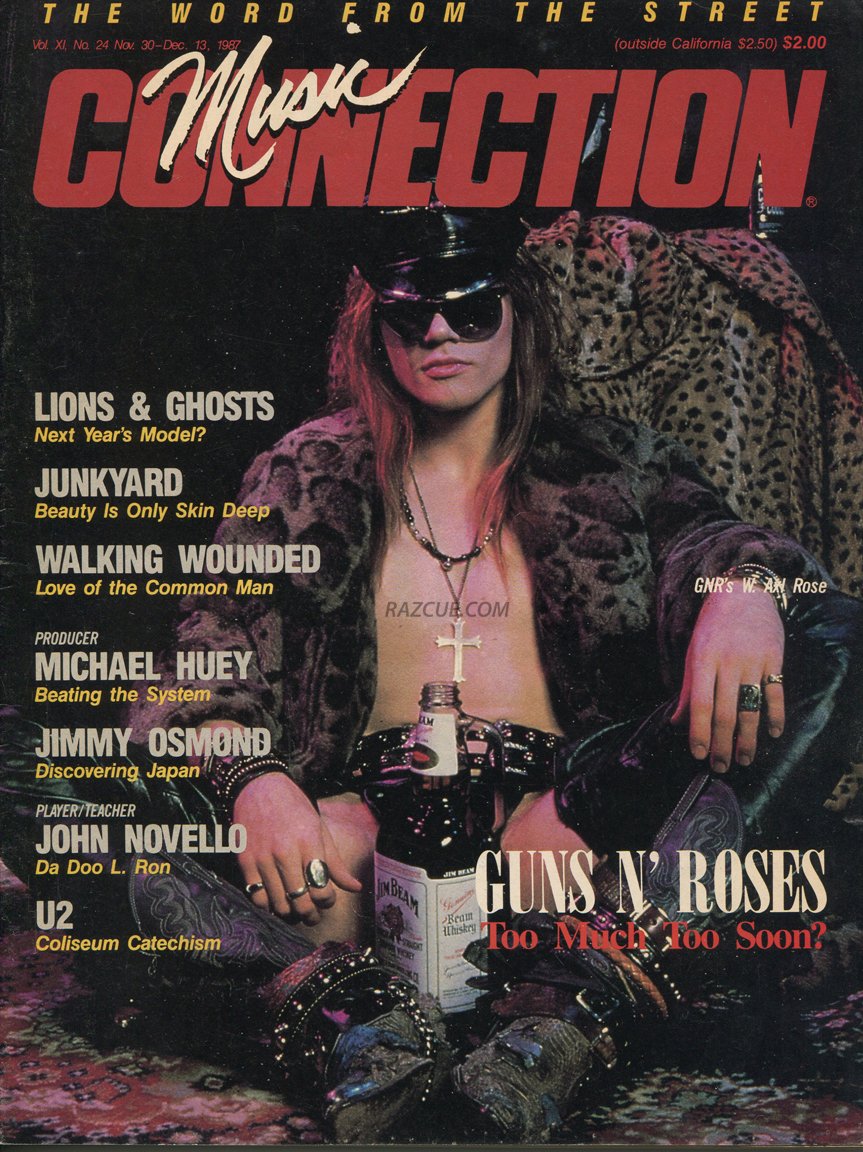
By the end of spring, G N’ R members were a rare sight around Hollywood. I’d still talk to Axl on the phone every few weeks. He actually checked in a few days after the single “It’s So Easy, Mr. Brownstone” was released. But I hadn’t heard it yet, so couldn’t offer an opinion. Axl promised he’d get me an album as soon as they were available. Within a week of that call, Guns N’ Roses was featured on a couple of major rock magazine covers. I was quite stoked to see the promo machine crank up for my buddy’s band.
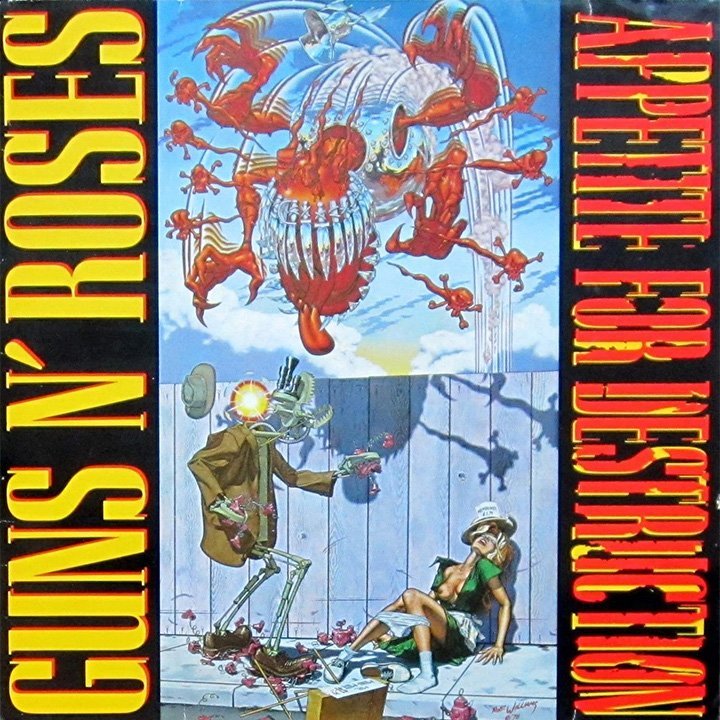
Then, the week before Appetite for Destruction got released, Axl gave me an LP with the awesome, frowned-upon-by-the-PMRC Robert Williams cover. It was a hot day, so several neighbors and I were out by the pool sipping moonshine and Coke when Joe showed up with the record. He proceeded to drag my speakers outside, then plopped the disc on the turntable and cranked that shit to an appropriate volume. My seventy-year-old property manager understood an entirely different definition of appropriate, so we hauled those speakers back inside to finish our white-lightning LP-listening.
I’m a big fan of Axl’s Marlboro-and-bourbon-cured vocal-cord shredding style, but until that day was unaware of how brilliant his lower register sounded.
I must have played the fucker five times in a row, while making cassettes for friends, each time getting blown away discovering new things going on in the mix. The entire time, I remained awed by the tunes’ evolution since the last time I heard them played live. Duff’s smooth-pounding pace, married with Steven’s solid raw drumming, surprised me with how much complexity fit into the straightforward driving, slamming of G N’ R’s thumping metal heart. I’m a big fan of Axl’s Marlboro-and-bourbon-cured vocal-cord shredding style, but until that day was unaware of how brilliant his lower register sounded. Then there was Slash’s amazing performance. I always knew he was great, but in the year-plus since the band was signed, his skills improved ten-fold to put him near top of the all-time heap. I did wish Izzy’s parts were a little more prominent in the mix, but my only real complaint was “Why isn’t ‘Don’t Cry’ on there?”
Joe told me the label wanted a guaranteed radio-friendly power ballad for the next record, and “Sweet Child” was a better song. I thought it was a mistake, and said, “What do those fools know?” Well, obviously more than me.
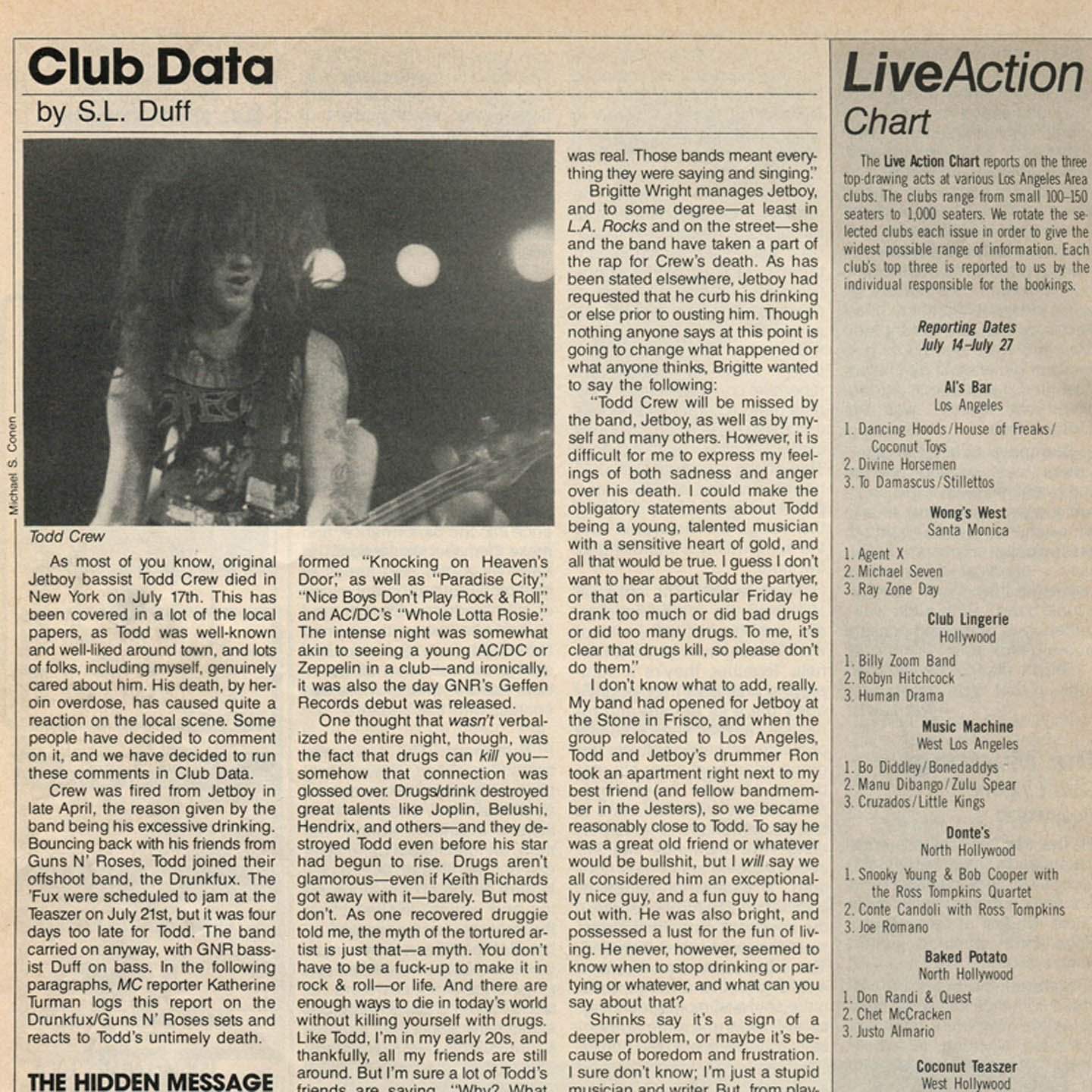
Guns N’ Roses threw a record release party at the Coconut Teaser. A few days before the event, we received some very sad news. A close friend, Todd Crew, who everyone loved, had passed away. What should have been a celebration turned somber when the party became a tribute performance for Todd’s random act of mortality. G N’ R added the heartfelt “Knocking on Heaven’s Door” to their repertoire, delivered with such a staggering depth of raw passion that whenever I play it back in my mind’s ear, it still elicits chills. The sheer emotion brought about by love for a fallen comrade produced one of the greatest Guns N’ Roses shows ever witnessed. To me, the most astounding thing about their performance, with the Teaser’s challenging acoustics and crappy PA, was that it was near impossible to sound good at that place.
Finally, during the third week of July, 1987, Appetite for Destruction was unleashed on the rock world like a rabid mutt cuckoo for Cujo-puffs. The sea change was not immediately clear to the old guard. A stuck-in-the-past L.A. Times music critic lumped G N’ R together with Faster Pussycat into a combined review. Then, after trashing Faster Pussycat, the writer basically said G N’ R wasn’t as bad. I believe the reviewer’s statement was, “Less flash, more panache.” I almost wrote a letter to that Times jackass, to hip him to what an idiot he was. But that’s not unusual. I’ve almost written hundreds of letters. Hell, it took me thirty years to write this shit. But if I would have written a cheesy review back in the day, it might have gone something like this:
And a one, and a two… It is universally accepted the rose represents true beauty, and to a patriot the individual liberty guaranteed by a gun is stunningly lovely in its own right. While the current crop of hard-rock bands sing of lipstick, liquor, and lap-dancing lovers, this Guns N’ Roses lyrical portrait, Appetite for Destruction, is an all-American tale of lust-dreams, love-struggles, pain, conquest, and the ultimate triumph of resolve. A collection of fiercely elegant songs about how it is, not tunes of what should be. Appetite’s overarching attitude offers a tantalizing cinematic glimpse from deep within the outsider, delivering a supersonic, hammering celebration from capitalism’s jack-bootstraps straight to the teeth of lesser-metal men who must then run to hide their unworthiness.
But I didn’t write a cheesy review. Well, not until the paragraph right above this one. Though I likely realized most of that fluff back in the day, for sure there’s some viewing through Guns N’ Rose-colored hindsight glasses. Speaking of hindsight, there is a case to be made of AFD being the last great rock vinyl LP record. You see, at the time of its release, compact discs had not yet fully dominated the market. We also had cassette tapes, thus splitting format choices into three. But the 33 & 1/3 rpm long-playing vinyl record remained the nostalgic king of the heap. So artists entered the recording studio focused on producing an LP record, with its total time length limited by physical grooves. Therefore, unless it was a double album, at the absolute maximum fifty-ish minutes’ worth of music was all a fan got. Bands were forced to self-edit their weaker material to fit those constraints. Unless their music was so outstanding it became impossible to decide what to dump, music lovers got truly great products such as Exile on Main St. and Goodbye Yellow Dicked Toad.
